Do Sudoku and Crosswords Protect Your Brain?
People often say puzzles keep the mind sharp. One careful study gives a more specific answer: they may go with higher ability, but they did not slow decline.
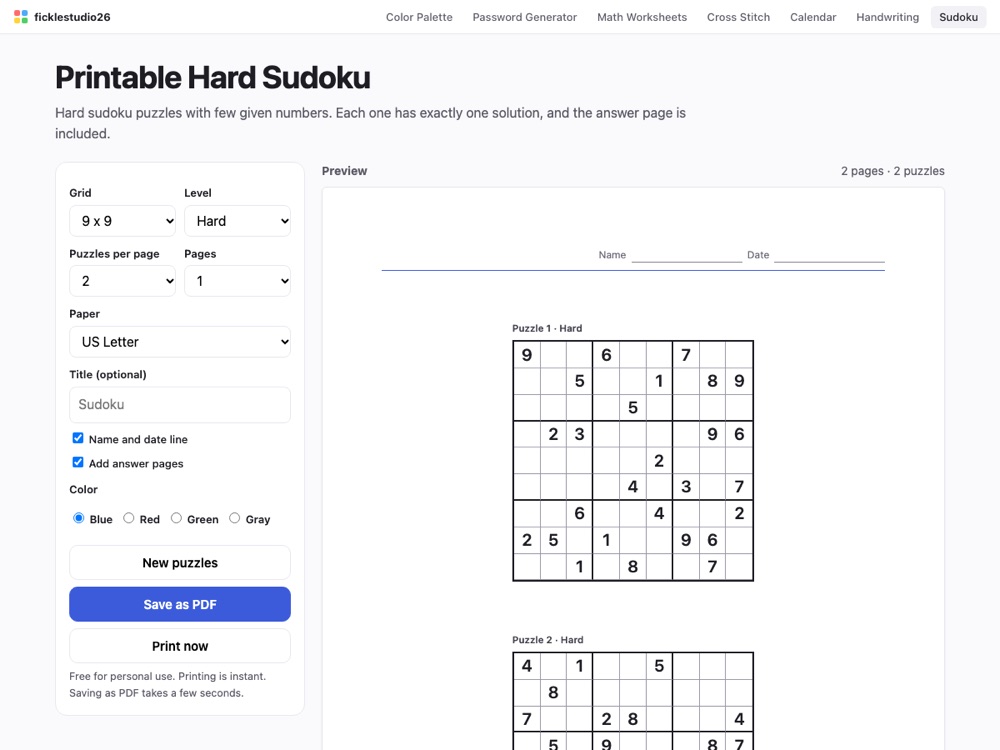 Print a sudoku
If you enjoy them, enjoy them. Easy, medium and hard puzzles with answers.
Open the tool →
The study
Researchers led by Roger Staff published a study in the BMJ in 2018. It followed 498 volunteers who were born in 1936 and lived independently in northeast Scotland. They took cognitive tests on up to five occasions over 15 years. Each person also reported how much they took part in mentally engaging activities. Problem-solving activities, such as puzzles, were one of the types counted.
What it found
- People who reported more mental engagement had higher scores on processing speed and memory in later life.
- Problem-solving activities showed the largest link with higher scores.
- The engagement did not change the pace at which scores declined with age.
In the authors' reading, a lifetime of mental activity goes with a higher starting point, not with a slower slide.
Why the result is hard to read
This was an observational study, so it cannot show cause and effect. Engagement was also linked with childhood ability and with education. Someone who scored well as a child may simply enjoy puzzles more and score well as an adult, whether or not the puzzles helped. It is also one cohort of older adults from one region, so it does not settle the question for everyone.
What this means for puzzle fans
The fair summary is that the research does not show that doing sudoku or crosswords prevents mental decline. It also does not show that they are bad for you. Puzzles can be a pleasant way to spend time, and that is a fine reason to do them. If you or someone close to you has concerns about memory, a doctor is the right person to ask. This article is general information, not medical advice.
Print a sudokuIf you enjoy them, enjoy them. Easy, medium and hard puzzles with answers.
Open the tool →
Sources
Checked on October 15, 2026. We summarize in our own words and only state what these sources support.
- BMJ: Intellectual engagement and cognitive ability in later life (the "use it or lose it" conjecture), 2018 — abstract and results
- PubMed record for the same paper