How Long Does It Take to Form a Habit?
You may have read that it takes 21 days, or 66. The 66 comes from a real study. The details are more interesting than the number.
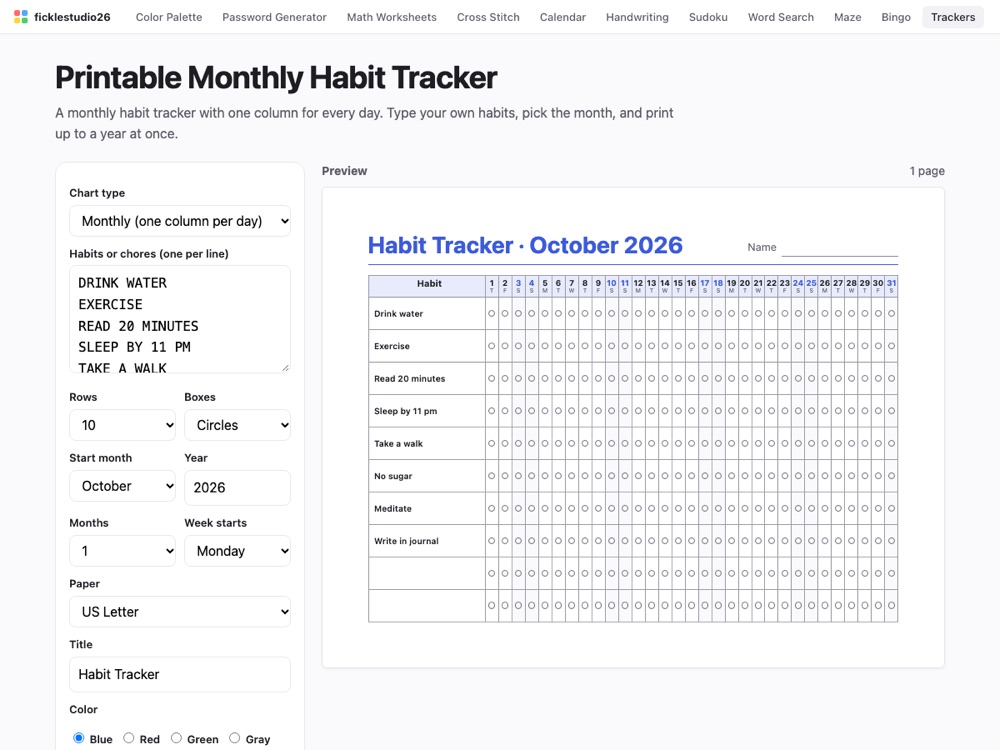 Print a habit tracker
A monthly grid for your own habits, or a weekly chore chart.
Open the tool →
The study
Phillippa Lally and colleagues at University College London followed 96 volunteers. Each chose one simple daily behavior, such as eating fruit at lunch or going for a run, and repeated it in the same situation each day. For about 12 weeks they rated how automatic the behavior felt. The paper appeared online in 2009 and in print in 2010 in the European Journal of Social Psychology.
What came out
- The typical time to reach a plateau of automaticity was about 66 days, reported as a median.
- Individual times ranged from 18 days to 254 days.
- Simpler behaviors became automatic faster than more demanding ones.
- Missing a single day did not seem to matter much, while many missed days in a row did.
Why 66 is not a rule
It was a median in a small group, and the range was huge. Reviews of the paper also point out that the measure relied on people judging their own behavior, and that the curve fit well for only part of the participants. Even the university's own commentary cautions against putting a single number on the process. The honest takeaway is that it varies a lot, and that it can take months.
What to do with it
If a habit is not automatic after three weeks, that is normal. A simple record can help you keep going, and a missed day is not a failure. The details above come from secondary summaries of the paper, so for exact figures read the original.
Print a habit trackerA monthly grid for your own habits, or a weekly chore chart.
Open the tool →
Sources
Checked on October 15, 2026. We summarize in our own words and only state what these sources support.
- Lally et al., How are habits formed: Modelling habit formation in the real world. European Journal of Social Psychology — study design and results, as summarized in secondary sources