Why Flash Cards Work
Flash cards are a form of self-testing. A well-known 2013 review ranked that approach near the top of ten common study techniques.
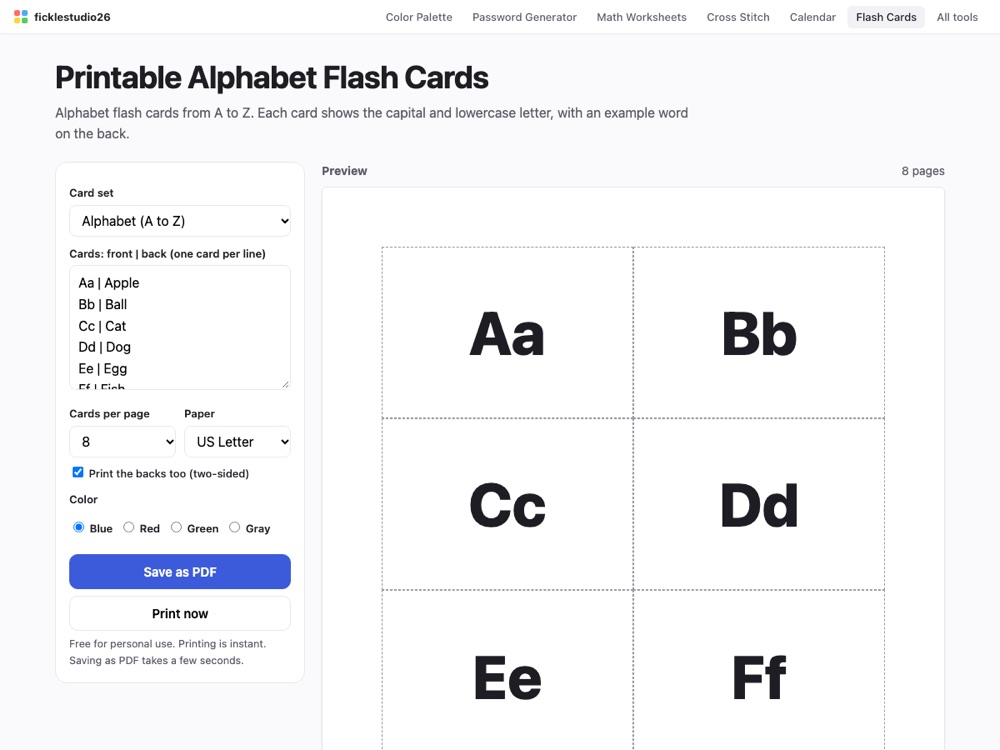 Make flash cards
Type a list, print the fronts and backs, and cut them out.
Open the tool →
The review
In 2013 John Dunlosky, Katherine Rawson, Elizabeth Marsh, Mitchell Nathan and Daniel Willingham reviewed ten popular learning techniques in the journal Psychological Science in the Public Interest. They rated each one on how useful it is for students of different ages and subjects.
What they rated highest
- Practice testing: quizzing yourself, or taking practice tests.
- Distributed practice: spreading study over several shorter sessions instead of cramming.
Both received the review's highest utility rating because they helped students of different ages and abilities across many kinds of tasks.
What they rated lowest
Summarizing, highlighting or underlining, and rereading received low utility ratings, even though they are among the most common student habits. One of the authors said that replacing rereading with delayed retrieval practice would help students.
What this means for flash cards
A flash card asks you to recall the answer before you look at it, which is practice testing. This is our own reading of the review, not a claim it makes about flash cards in particular. To get the second benefit, go through your cards in short sessions over several days, and put the ones you miss back in the pile. Keep each card to one fact or question.
Make flash cardsType a list, print the fronts and backs, and cut them out.
Open the tool →
Sources
Checked on October 15, 2026. We summarize in our own words and only state what these sources support.
- Dunlosky et al. (2013), Improving students' learning with effective learning techniques. Psychological Science in the Public Interest, 14(1), 4–58 — ratings of the ten techniques
- Association for Psychological Science: Which Study Strategies Make the Grade? — press summary