When Should Kids Know Their Multiplication Facts?
The short answer from the Common Core is: by the end of Grade 3. Here is what that standard says, how big the job really is, and what a recent national test can and cannot tell us.
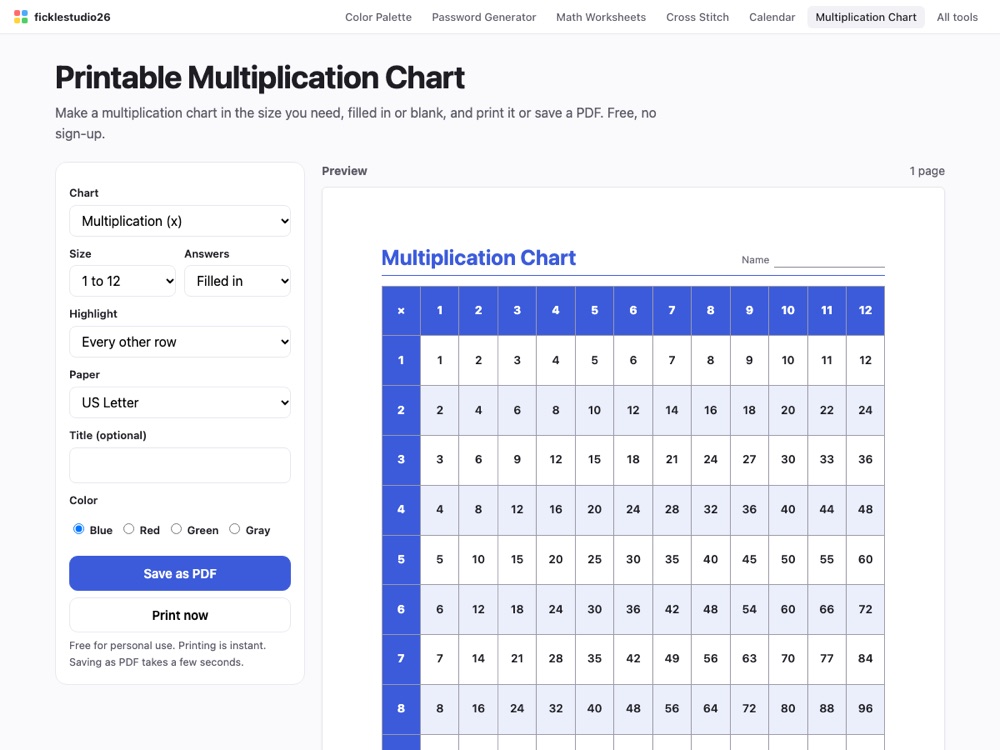 Print a multiplication chart
A filled chart for reference, then a blank one to practice recall. Sizes from 1–10 up to 1–20.
Open the tool →
What the standard says
Standard 3.OA.C.7 in the Common Core State Standards for Mathematics has two parts. Students should fluently multiply and divide within 100, and by the end of Grade 3 they should know from memory all products of two one-digit numbers. Many US states adopted these standards or built their own on them, so check your state's wording and grade timing.
How many facts is that, really?
Single digits from 0 to 9 make 100 pairs, which looks like a lot. But 6 × 7 and 7 × 6 are the same fact, so there are 55 different facts. Set aside the 0s and 1s, which follow simple rules, and the facts using digits 2 to 9 come to 36. That is the part that takes real practice, and it is smaller than the full table suggests. (This is our own arithmetic, not a figure from the standards.)
What the 2024 NAEP shows
The National Assessment of Educational Progress (NAEP) tested a national sample of Grade 4 students in math in early 2024. The headline numbers from the Nation's Report Card:
- The average Grade 4 score was 2 points higher than in 2022 and 3 points lower than in 2019.
- 39% of students were at or above the NAEP Proficient level. That is up 3 points from 2022 and down 2 points from 2019.
- 24% were below the NAEP Basic level. That is down 1 point from 2022 and up 5 points from 2019.
- Scores at the 10th and 25th percentiles, the lower-performing students, did not change significantly from 2022.
NAEP measures fourth-grade math as a whole. It does not report how many children know their multiplication facts, so these results do not tell us that. What they do show is that, after a drop, the overall picture has partly recovered, while the lowest-scoring students have not moved yet.
A practical way to use a chart
This part is a suggestion, not a research finding. Start with a filled chart so a child can check answers and notice patterns, such as the 9s or the doubles. When the chart is no longer needed for most facts, switch to a blank one and fill it in from memory. Keep sessions short and come back to the facts that still need work.
Print a multiplication chartA filled chart for reference, then a blank one to practice recall. Sizes from 1–10 up to 1–20.
Open the tool →
Sources
Checked on October 15, 2026. We summarize in our own words and only state what these sources support.
- Common Core State Standards: Grade 3, Operations and Algebraic Thinking (3.OA.C.7) — multiplication fluency standard
- The Nation's Report Card: 2024 NAEP Mathematics, Grades 4 and 8 — Grade 4 results