How Many Sudoku Grids Are There?
A sudoku puzzle looks small, yet the number of possible completed grids is enormous. Here are the numbers, and what "17 clues" means.
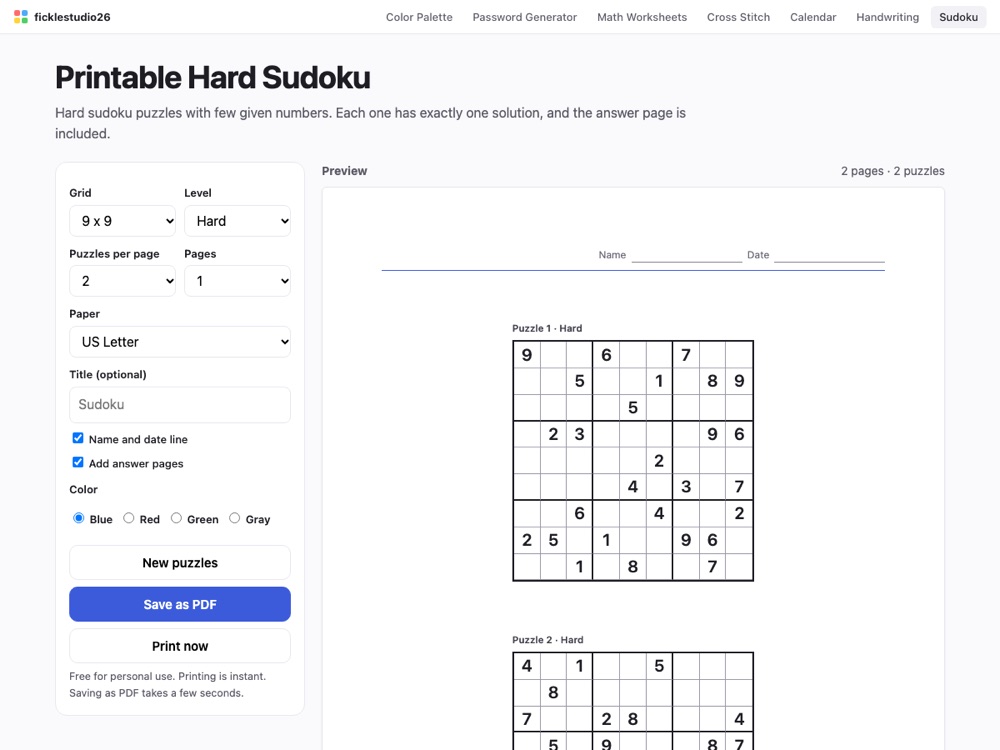 Make a sudoku puzzle
Every puzzle is fresh and has exactly one solution.
Open the tool →
Completed grids
The number of valid completed 9×9 sudoku grids is 6,670,903,752,021,072,936,960, about 6.67 × 10²¹. That is a count of every way to fill the grid so each row, column and 3×3 box holds the digits 1 to 9 once.
Counting "different" grids
Many of those grids are the same puzzle in disguise: you can swap the digit labels, rotate or reflect the grid, or swap certain rows and columns. If you count grids that cannot be turned into each other by these changes, the number drops to 5,472,730,538. Wikipedia credits Ed Russell and Frazer Jarvis with computing it, announced in 2005 and 2006.
The smallest number of clues
A puzzle with a single solution needs enough starting numbers (clues) to rule out every other grid. The smallest number that can work is 17. A 2014 paper by Gary McGuire, Bastian Tugemann and Gilles Civario proved that no puzzle with 16 clues has a unique solution, using an exhaustive computer search. This does not mean a 17-clue puzzle is easy. Puzzles with few clues are often hard to solve.
Why it matters for puzzle makers
A good puzzle must have exactly one solution. A generator therefore has to check candidate puzzles, because removing a clue can open the door to a second solution. This is also why the number of clues alone does not set the difficulty.
Make a sudoku puzzleEvery puzzle is fresh and has exactly one solution.
Open the tool →
Sources
Checked on October 15, 2026. We summarize in our own words and only state what these sources support.
- Wikipedia: Mathematics of Sudoku — grid counts and the 17-clue result