How to Solve Sudoku Without Guessing
A well-made sudoku never needs a guess. Two basic techniques solve most easy and medium puzzles, and they are the base for harder ones.
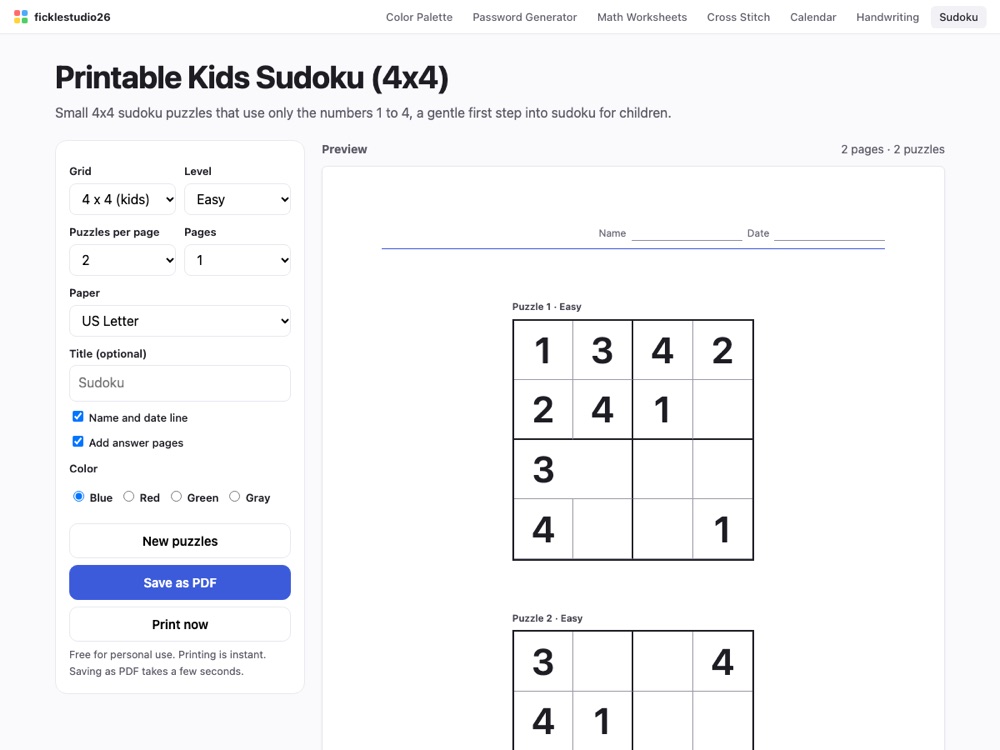 Print an easy sudoku
Start with an easy puzzle, or try the 4×4 kids version.
Open the tool →
The rule
Fill the grid so each row, each column and each 3×3 box contains the digits 1 to 9 exactly once.
Technique 1: hidden singles
Pick a digit, say 5. Look at a row, column or box and ask: where can a 5 go here? Cross out every cell that already has a number, and every cell that shares a row, column or box with another 5. If only one cell is left, the 5 goes there. Repeat for each digit and each box, and the grid starts to fill in.
Technique 2: naked singles
Look at one empty cell instead. Which digits are already in its row, its column and its box? If eight different digits are ruled out, only one remains, and it goes in the cell. Writing small pencil marks of possible digits in each cell makes this easy to see.
A routine that works
- Scan each digit across the grid and place any hidden singles.
- When that stalls, write small candidates in the empty cells and look for cells with only one candidate.
- Each new number removes candidates elsewhere, so go back to step 1.
If you get stuck on a puzzle that is meant to have one solution, there is always a logical next step. Re-check the candidates you wrote, because a single wrong mark is the usual cause.
Starting small
The 4×4 kids version uses the digits 1 to 4 and 2×2 boxes. It is a good place to practice both techniques before moving to the full grid.
Print an easy sudokuStart with an easy puzzle, or try the 4×4 kids version.
Open the tool →
Sources
This post is a how-to. It does not rely on outside studies or statistics.