Wide Ruled vs College Ruled Paper
The names are familiar, but the actual line spacing is easy to forget. Here are the standard measurements and what they are good for.
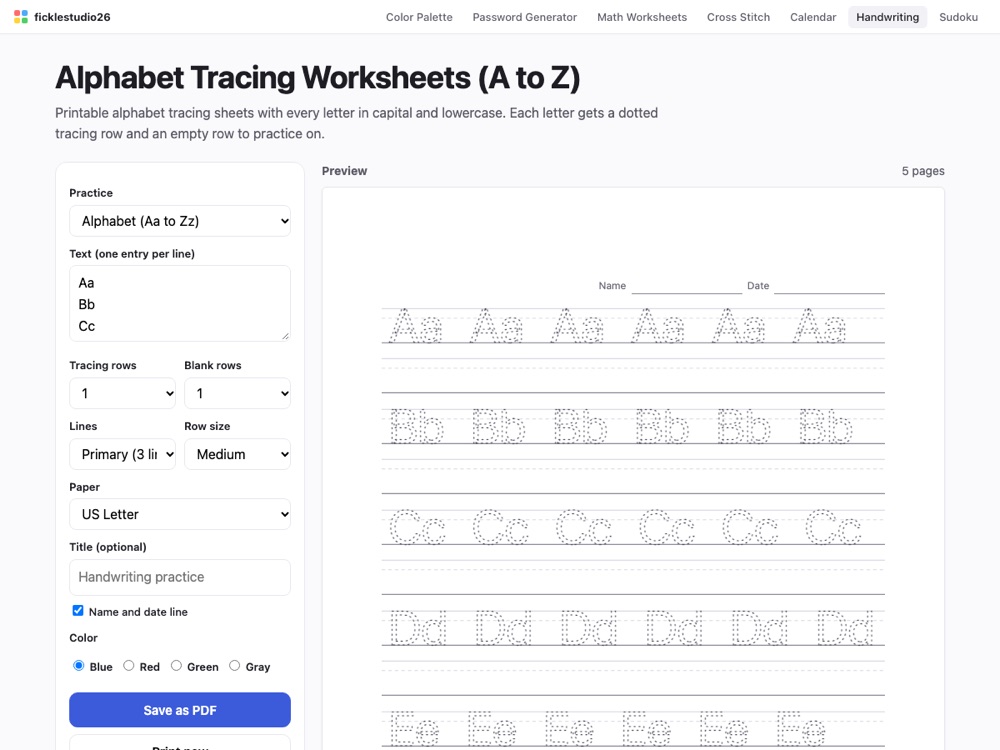 Print lined paper
Choose the line spacing and add guide lines for handwriting practice.
Open the tool →
The measurements
| Type | Line spacing |
|---|---|
| Wide ruled (legal ruled) | 11/32 in (8.7 mm) |
| Medium ruled (college ruled) | 9/32 in (7.1 mm) |
| Narrow ruled | 1/4 in (6.4 mm) |
US standards. The millimeter values are conversions. Other countries use different standards: 8 mm is a common adult ruling in the UK, for example.
Which to use
This part is practical advice, not a rule. Wide ruled leaves room for bigger letters, so it suits younger children and anyone who writes large. College and narrow ruled fit more lines on a page and suit older students and note-taking.
A little history
Paper used to be ruled by hand, sometimes by pressing lines into it with a hard point or marking it faintly with a metal point. In 1770 the English inventor John Tetlow patented a machine for ruling music paper and other kinds. In the mid-1800s William Orville Hickok built a ruling machine of his own.
Printing your own
When you print lined paper at home, check that the size is set to actual size and not "fit to page", otherwise the spacing will not match the numbers above.
Print lined paperChoose the line spacing and add guide lines for handwriting practice.
Open the tool →
Sources
Checked on October 15, 2026. We summarize in our own words and only state what these sources support.
- Wikipedia: Ruled paper — line spacings and history