Types of Graph Paper and a Short History
Graph paper looks simple, but there are many kinds. Here are the common ones, what they are used for, and where the idea came from.
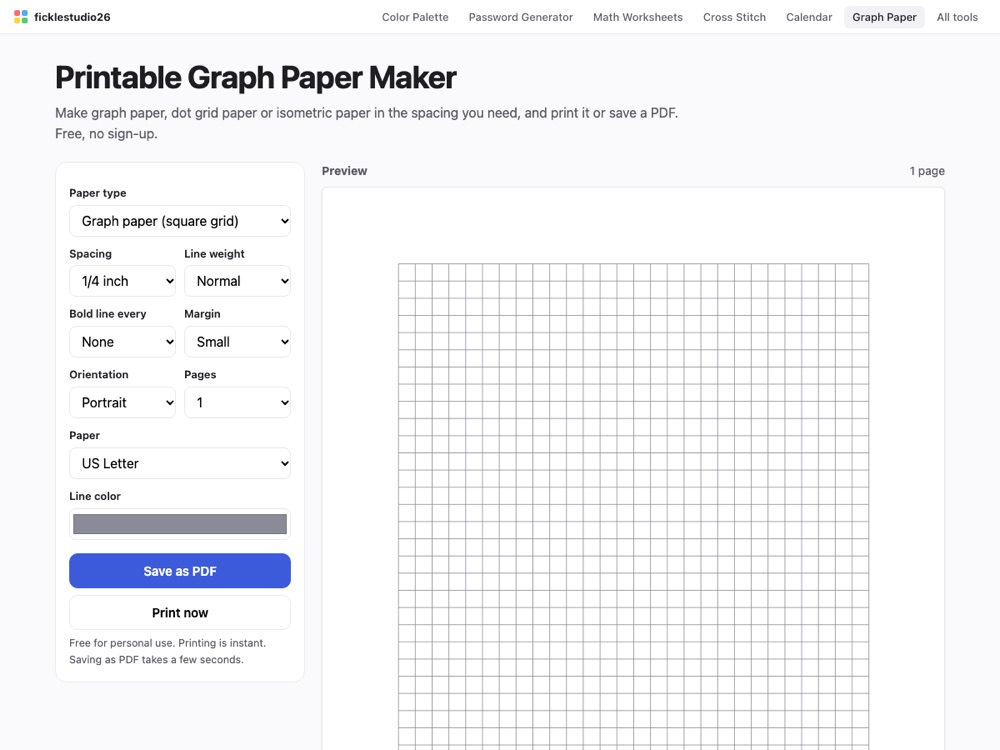 Print graph paper
Square grid, dot grid and more, in your spacing and color.
Open the tool →
Common types
- Quad (quadrille) paper: a light grid. In the US and Canada it commonly has 2, 4 or 5 squares per inch, and in Europe it is usually 5 mm squares.
- Engineering paper: a grid with 4, 5 or 10 squares per inch on translucent paper whose lines often disappear in copies and scans.
- Millimeter paper: 10 squares per centimeter, used in technical drawing.
- Dot grid: dots at the intersections instead of lines. Popular with bullet journals.
- Isometric paper: a triangular grid at 60° for drawing 3D-looking shapes.
- Hexagonal, polar, log and probability paper: specialized kinds for tiling, circles, and scientific plots.
A short history
The Metropolitan Museum of Art holds a pattern book from around 1596 with printed grids on its pages. The first commercially published coordinate paper is usually credited to a Dr. Buxton of England, who patented it in 1794. About a century later E. H. Moore, a mathematician at the University of Chicago, argued for the use of squared paper in high schools and universities. The name "graph paper" was slow to catch on in American usage, and for a while books used "coordinate paper" or "squared paper" instead.
Choosing one
For plotting a function, use a square grid and label the axes. For drawing in 3D, isometric paper helps. For notes and sketches, dot grid keeps the page clean. A finer grid fits more detail, and a coarser one is easier to read.
Print graph paperSquare grid, dot grid and more, in your spacing and color.
Open the tool →
Sources
Checked on October 15, 2026. We summarize in our own words and only state what these sources support.
- Wikipedia: Graph paper — types, spacings and history