The History of Bingo
The game in your community hall has a long family tree, from 16th-century Italy to a carnival near Atlanta.
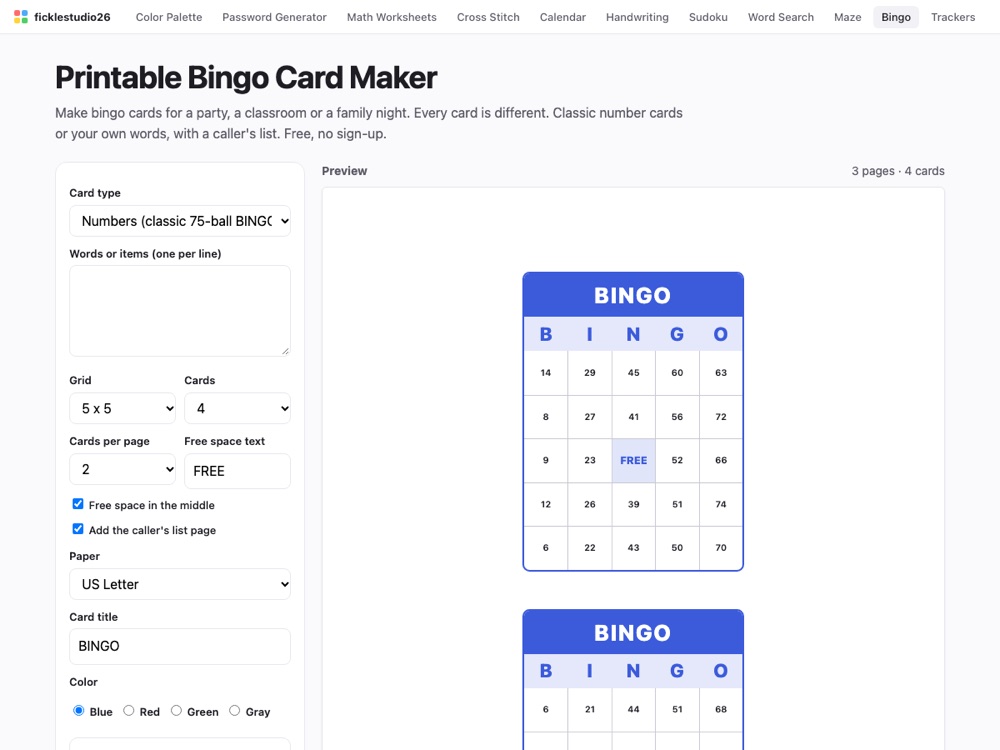 Make bingo cards
Classic numbers or your own words, with a caller sheet.
Open the tool →
Early roots
A lottery game called lotto was played in Italy by about 1530. In 18th-century Naples a home version called Tombola added cards, tokens and called numbers. The French game Le Lotto appeared in 1778 with a grid of three rows and nine columns, which led to the card layout we know.
The American game
In the early 1920s Hugh J. Ward standardized a version of the game at carnivals around Pittsburgh, and he published a rule book in 1933. In December 1929, the toy merchandiser Edwin S. Lowe saw people playing a game called Beano at a carnival near Atlanta. He took it to New York. During the Great Depression it spread, and Catholic churches used it for fundraising. By the 1940s bingo was played across the US.
The name
Nobody knows for certain where the name comes from. One story says a player shouted it by mistake instead of "Beano".
The standard card
The American 75-ball card is a 5×5 grid with the letters B, I, N, G, O over the columns and a free space in the center. The columns use these number ranges: B 1–15, I 16–30, N 31–45, G 46–60, O 61–75.
Make bingo cardsClassic numbers or your own words, with a caller sheet.
Open the tool →
Sources
Checked on October 15, 2026. We summarize in our own words and only state what these sources support.
- Wikipedia: Bingo (American version) — history and card layout