Maze vs Labyrinth
Are they the same? In daily use, yes. In a stricter sense, no, and the difference is whether you ever have to choose.
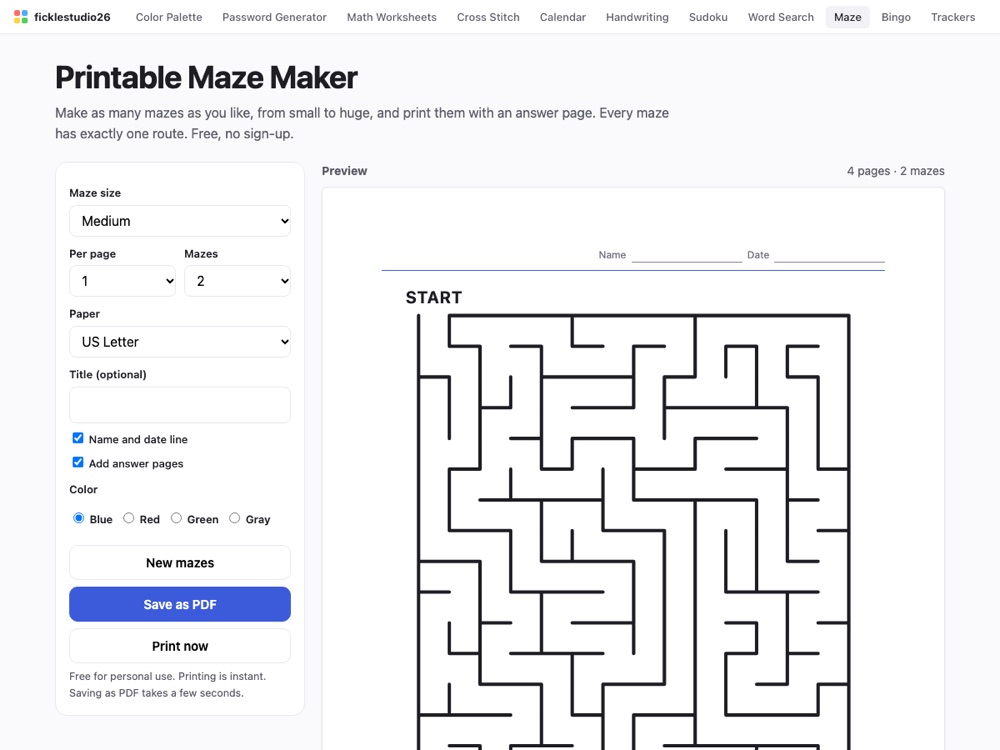 Make a maze
Easy to hard sizes, with an answer page for each.
Open the tool →
Usually the same
Most dictionaries and reference works treat "labyrinth" as generally synonymous with "maze". In everyday speech you can use either word for a puzzle of winding paths.
The stricter distinction
Some writers use "labyrinth" for a pattern with a single path, one that winds to the center without any branches, so you cannot get lost. A maze, in this sense, is a puzzle with branching paths where you must choose which way to go and may reach dead ends. Wikipedia describes a maze as either a branching tour puzzle or a simpler non-branching pattern, which shows that even reference works use the terms loosely.
Famous examples
The Hampton Court Palace maze, in the palace gardens, is a famous historic hedge maze. Larger ones exist: the Samsø Labyrinten in Denmark is described as the world's largest permanent maze at 60,000 square meters.
On paper
The printable mazes here have a start, a finish and dead ends, so they are mazes in the stricter sense. Each comes with an answer page.
The word and the myth
In Greek myth, Daedalus built the Labyrinth for King Minos of Crete, at Knossos, to hold the Minotaur, which Theseus eventually killed. The origin of the word "labyrinth" is uncertain and is described as pre-Greek. One old suggestion links it to labrys, a word for a double-bladed axe, but a modern scholar considers that link speculative.
The classical pattern
The seven-course "Classical" or "Cretan" pattern has no branches and no dead ends: one path winds to the center. It appears on Cretan coins from about 430 BC, with the common examples dated to roughly 400 to 200 BC. From Roman times until the Renaissance, drawn labyrinths are almost always of this single-path kind. Roman floor mosaics typically join four copies of the pattern around a center, and many show the Minotaur there.
Church labyrinths
Labyrinths began to appear on church walls and floors around the year 1000, and the medieval form flowered from the 12th to the 14th century, with pavement labyrinths at Chartres, Reims and Amiens in northern France. The Chartres design is the most common medieval pattern, and the cathedral's labyrinth is dated to the early 1200s. The earliest known church example is a 4th-century pavement at the Basilica of St Reparatus in Algeria. Today, walking a labyrinth is used as a form of active meditation; faith-based researchers claim it calms the mind, while secular studies of stress reduction are still ongoing.
Solving a maze on paper
- Wall following (keep one hand on a wall): it works when the maze is simply connected, meaning all its walls join each other or the outer boundary. It can fail if you start inside a separate wall, because you may circle that wall forever.
- Dead-end filling: if you can see the whole maze, as on paper, shade in each dead end back to its first junction, and repeat. In a maze with no loops only the solution remains.
- Trémaux's method: mark each passage as you enter it. It is guaranteed to work for any maze with well-defined passages, but it does not promise the shortest route.
- Random mouse: choose a direction at every junction. It always gets there eventually, but it can take very long.
For a printed maze with an answer page, dead-end filling is the quickest way to check yourself.
Make a mazeEasy to hard sizes, with an answer page for each.
Open the tool →
Sources
Checked on October 25, 2026. We summarize in our own words and only state what these sources support.
- Wikipedia: Maze — terminology and examples
- Wikipedia: Labyrinth — myth, classical pattern, Roman and medieval labyrinths
- Wikipedia: Maze-solving algorithm — wall following, dead-end filling, Trémaux, random mouse