Who Invented the Word Search?
Word searches are everywhere in classrooms and puzzle books, yet their origin is surprisingly local. Here is what is known, and what is still disputed.
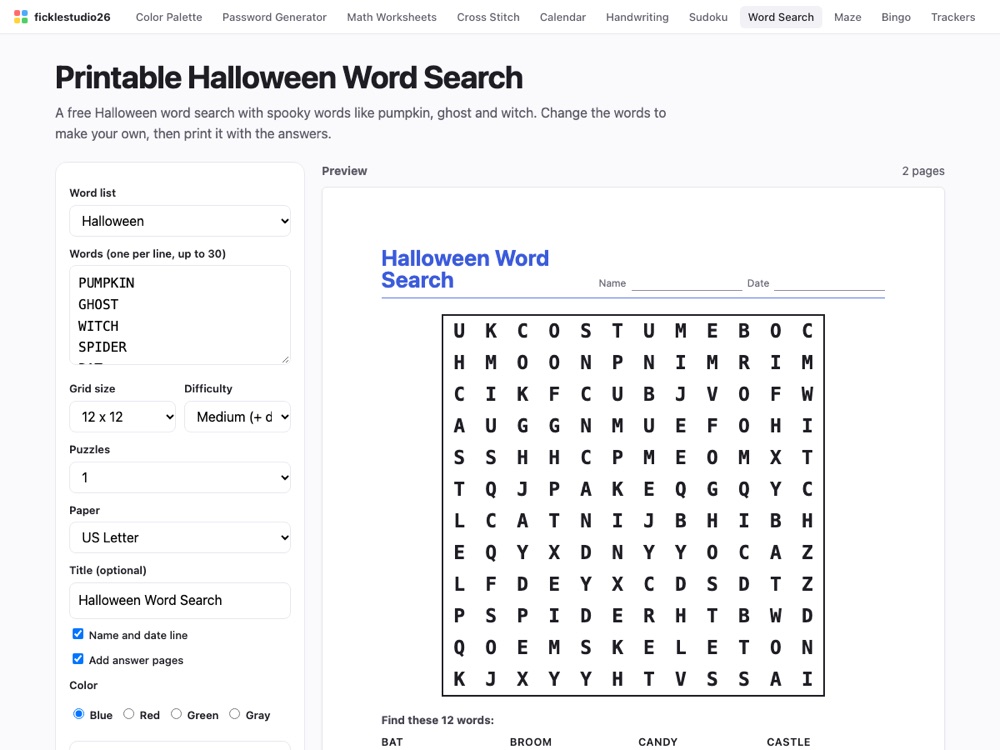 Make a word search
Pick a theme or type your own words. Every puzzle comes with an answer page.
Open the tool →
The usual answer
Norman E. Gibat is generally credited with designing the word search. He published one in the Selenby Digest on March 1, 1968, in Norman, Oklahoma. It was popular locally. Teachers in Norman asked for reprints for their classrooms, and one teacher sent copies to friends at other schools across the country. Wikipedia's account suggests this word of mouth eventually led to the puzzle being sold to a syndicator.
Earlier claims
The same article mentions earlier claims, but treats them with caution. One says that the Spanish puzzle creator Pedro Ocón de Oro published "Sopas de letras" before 1968, and the article marks that claim as needing a citation. Another says that James Patrick Carr of Villa Grove, Illinois, very likely made such puzzles earlier, and points to high school sports brochures as evidence. So "invented in 1968" is the first well-documented publication, not necessarily the very first word search.
Why it caught on
A word search needs no special knowledge, uses a theme anyone can pick, and is easy for a teacher to make and copy. Those same qualities make it popular for classroom vocabulary lists and holiday activities today.
Names and variants
The puzzle is also called word find, word seek, word sleuth or mystery word, and WordSeek, WordFind and WonderWord have all been used as names. Common variants are:
- Secret message: the leftover letters, or words written backward, spell a hidden message.
- Trivia: an extra hidden phrase answers a question.
- Snaking puzzles: words turn at letters (90 degrees, and in some cases 45), sometimes tracing a shape.
From newsprint to screens
The puzzle moved from a local newspaper to classrooms by photocopy and mail, and then to puzzle books. In the 1970s a CBS game show, Now You See It, adapted it for television. Online it appeared as casual browser and phone games, such as Facebook's Letters of Gold in 2013.
In teaching
Teachers use word searches as vocabulary activities, especially in language and English-as-a-second-language classes, and as recreation. The Wikipedia article does not report research on learning benefits, so we make no claim about them. An answer page lets students check their own work.
Teachers also play the April Fools' joke of a word search with no actual words, and the puzzle is used as a simple way to demonstrate searching algorithms.
Make a word searchPick a theme or type your own words. Every puzzle comes with an answer page.
Open the tool →
Sources
Checked on October 25, 2026. We summarize in our own words and only state what these sources support.
- Wikipedia: Word search — Gibat's publication and the earlier claims
- Wikipedia: Word search — names, variants, spread and uses