A Short History of the Bookmark
A bookmark is about the simplest tool there is, and it is older than the printed book.
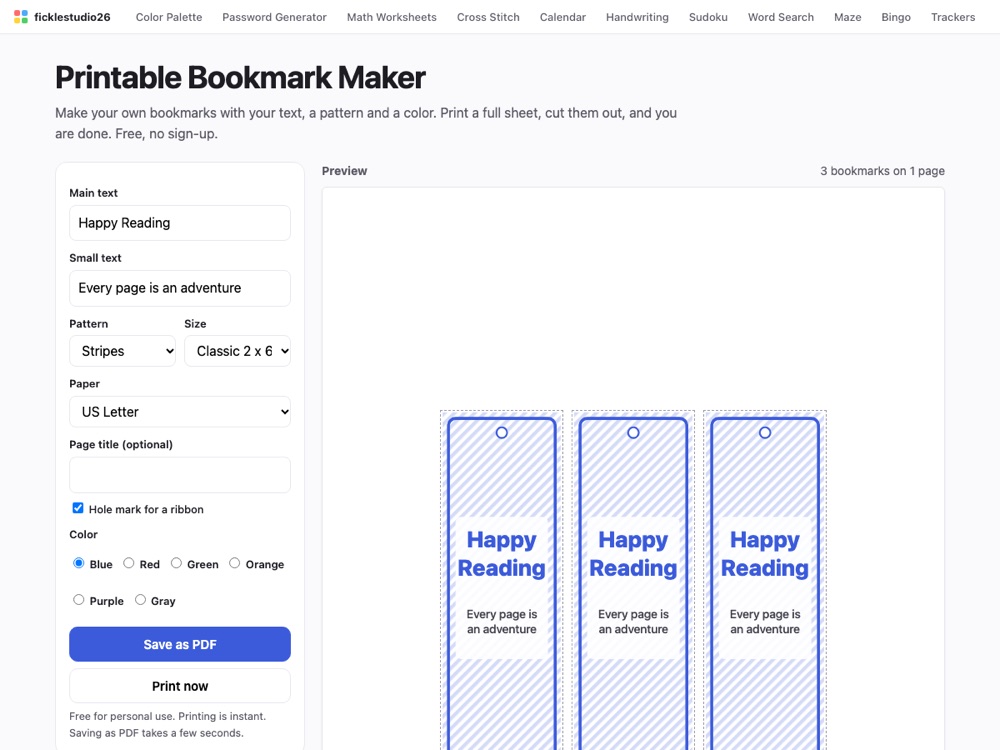 Make a bookmark
Add your own text, a pattern and a color, and print several to a page.
Open the tool →
The oldest one
Research cited by Wikipedia indicates that bookmarks came with codices, the early book form, from the first century AD. The earliest surviving example is a 6th-century piece of ornamented leather lined with vellum and attached by a leather strap to a Coptic codex. It was found near Sakkara in Egypt.
In the Middle Ages
Bookmarks were common. Typically they were a small strip of parchment attached to the edge of a page, or a cord attached to the top of the book's spine.
The 19th century
Separate bookmarks that were not fixed to a book began to appear in the 1850s. Machine-woven ones followed in the 1860s, mostly in Coventry, England. One of the earliest, from J. and J. Cash, marked the death of Prince Albert in 1861. The English silk weaver Thomas Stevens made woven picture bookmarks from about 1862 that are known as Stevengraphs. Most 19th-century bookmarks were ribbon, woven silk or leather, and were used mainly in Bibles and prayer books. By the 1880s woven silk markers were declining and printed paper or card ones were becoming common.
Today
Printed paper bookmarks are cheap and easy to make at home. Many people give them out as small gifts, class rewards or prizes for a reading challenge.
Make a bookmarkAdd your own text, a pattern and a color, and print several to a page.
Open the tool →
Sources
Checked on October 15, 2026. We summarize in our own words and only state what these sources support.
- Wikipedia: Bookmark — history from the 1st century to the 19th century