Patterns in the Multiplication Table
Learning facts one by one is slow. Spotting patterns makes many of them easier, and the Common Core even lists it as a skill for Grade 3.
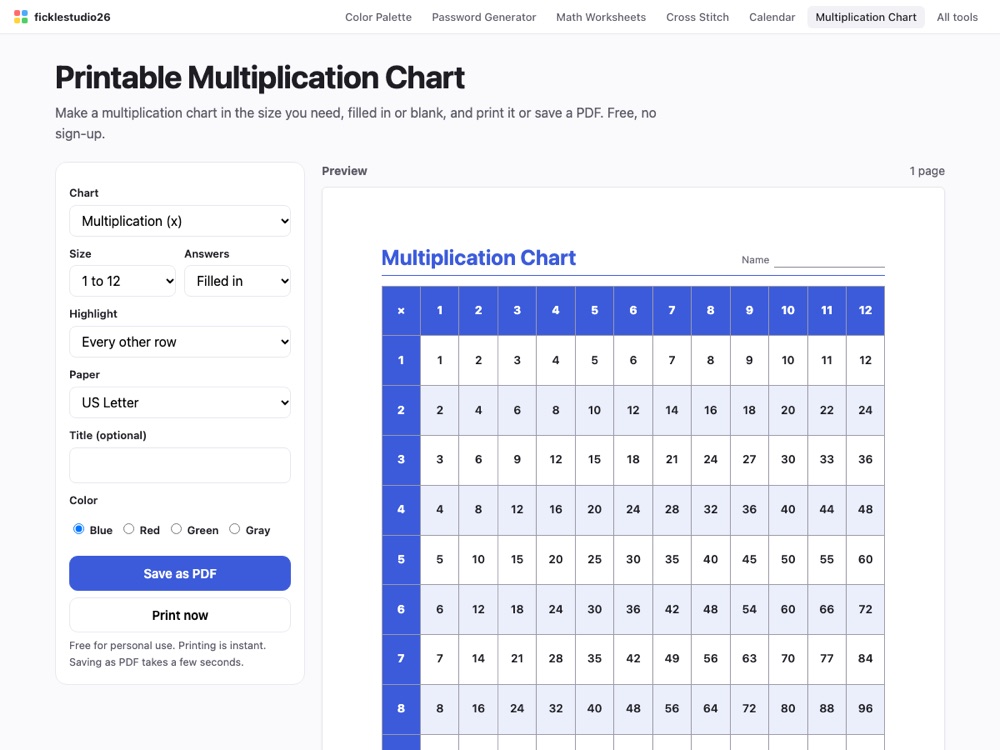 Print a multiplication chart
Use the filled chart to find the patterns, then a blank one to practice.
Open the tool →
The standard behind it
Standard 3.OA.D.9 in the Common Core asks Grade 3 students to identify arithmetic patterns, including patterns in the addition or multiplication table, and to explain them using properties of operations.
Patterns you can check
- The 9s: for 9 × 1 up to 9 × 10, the digits of each answer add up to 9 (18 gives 1 + 8, 63 gives 6 + 3, 90 gives 9 + 0). The tens digit is also one less than the number you multiply by, up to 9 × 9.
- The 5s: every answer ends in 0 or 5, alternating.
- The 10s: add a zero to the number.
- The 11s up to 9 × 11: repeat the digit (11, 22, 33 and so on up to 99).
- The 2s: these are the doubles. Every answer is even.
- Even and odd: an even number times any whole number gives an even answer. An odd times an odd gives an odd answer.
Why the 9s work
9 × n is the same as 10 × n − n. Subtracting n from 10n lowers the tens digit by 1 and leaves a ones digit that makes the digit sum 9. This is the kind of explanation by properties of operations that the standard asks for.
Using it
A filled chart makes these patterns easy to see: shade the 9s, or the squares on the diagonal. Then try a blank chart and fill in the facts you know. Start with the easiest patterns and leave the hardest facts for last.
Print a multiplication chartUse the filled chart to find the patterns, then a blank one to practice.
Open the tool →
Sources
Checked on October 15, 2026. We summarize in our own words and only state what these sources support.
- Common Core State Standards: Grade 3, Operations and Algebraic Thinking (3.OA.D.9) — the pattern standard